

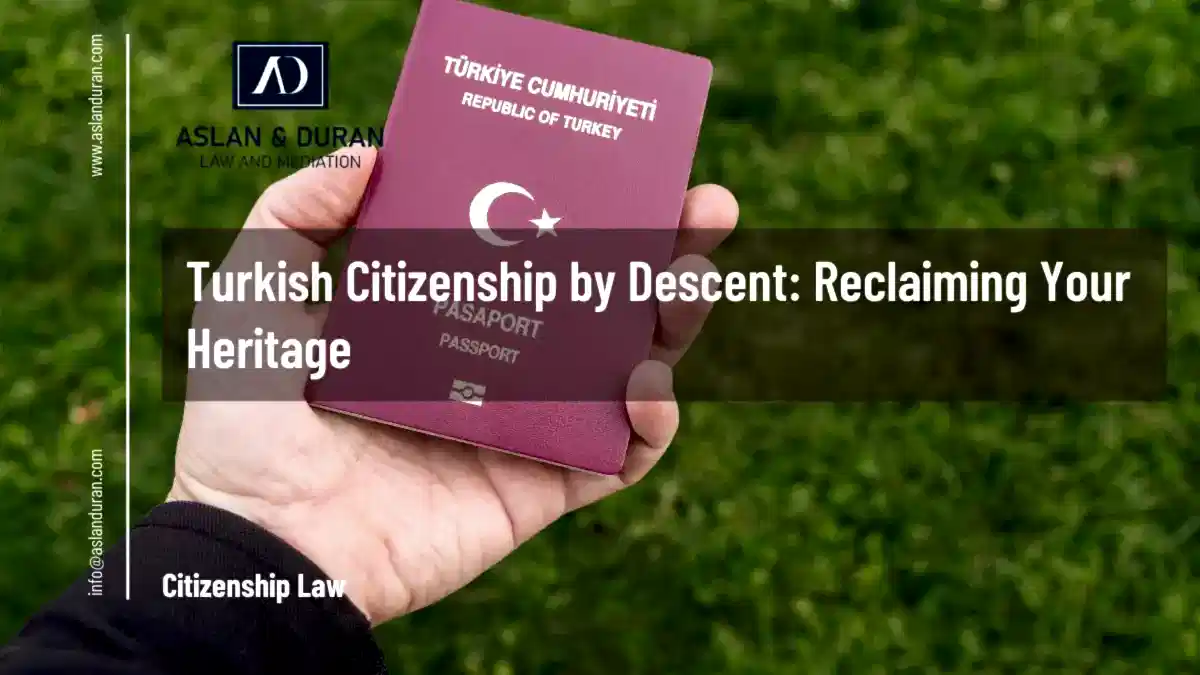
Citizenship is more than just a legal status; it is a bond of identity, culture, and heritage. For many individuals around the world who have Turkish roots, acquiring Turkish citizenship is not just a strategic move for a second passport but a way to reconnect with their ancestry. Unlike the popular investment routes, acquiring Turkish Citizenship by Descent is not based on financial contribution but on the legal principle of “Jus Sanguinis” (Right of Blood). This means that if you have a Turkish mother or father, you may already be a Turkish citizen in the eyes of the law, even if you were born outside of Turkey and have never set foot in the country.
However, the process is not always automatic or straightforward. Bureaucratic hurdles, missing archives, and complex residency rules can turn a simple registration into a legal maze. At Aslan Duran Law Firm, our specialized Turkish citizenship lawyer team assists individuals worldwide in proving their lineage and officially reclaiming their Turkish identity.
In this comprehensive guide, we will explore the legal framework of citizenship by descent, the eligibility criteria, and the procedural steps to secure your Turkish ID.
The Legal Basis: Jus Sanguinis vs. Jus Soli
To understand your eligibility, you must first understand how Turkey defines citizenship.
Jus Soli (Right of Soil): This is the principle used by countries like the USA or Brazil, where being born on the country’s territory grants citizenship. Turkey does NOT follow this rule. Being born in a hospital in Istanbul does not make a child Turkish if the parents are foreigners.
Jus Sanguinis (Right of Blood): This is the core of Turkish Citizenship Law No. 5901. Article 7 clearly states: “A child born to a Turkish mother or a Turkish father within or outside Turkey is a Turkish citizen.”
This implies that citizenship is transmitted through parentage, not geography. Whether you were born in Berlin, New York, or London, if one of your parents was a Turkish citizen at the time of your birth, you have a constitutional right to citizenship.
Who Is Eligible for Turkish Citizenship by Descent?
Eligibility usually falls into three distinct categories. Identifying which category you belong to is the first step in the legal process.
A. Children Born to at Least One Turkish Parent
This is the most direct route. If your mother or father (or both) held Turkish citizenship at the moment you were born, you are considered a Turkish citizen by birth.
Marital Status Matters:
If the mother is Turkish: The child acquires citizenship automatically, regardless of whether she is married to the foreign father or not.
If the father is Turkish: If the child is born within a marriage, citizenship is automatic. If the child is born out of wedlock to a Turkish father and a foreign mother, the father must officially recognize the child (acknowledgment of paternity) or paternity must be established by a court order to transmit citizenship.
B. Those Who Lost Citizenship (Renunciation)
Many Turkish citizens who migrated to countries like Germany, Austria, or the Netherlands in the past had to renounce their Turkish citizenship to naturalize in their host countries (due to bans on dual citizenship at the time). If you or your parents renounced citizenship with official permission (Permission to Leave), you have a privileged right to re-acquire it. This procedure is generally faster than general naturalization, provided there are no national security obstacles.
C. Ottoman Ancestry (The Complex Route)
We frequently receive inquiries asking, “My grandfather was born in the Ottoman Empire; can I become a Turkish citizen?” This is a legally complex area. The modern Republic of Turkey was founded in 1923. Establishing a link to Ottoman ancestors requires proving that those ancestors did not lose their status during the transition from the Empire to the Republic and that they maintained a legal bond with the state. While difficult, it is not impossible if solid archival documents can be retrieved.
The Registration Process: Step-by-Step
If you fall under the “Jus Sanguinis” category, you are technically not “applying” for citizenship; you are registering a status that already exists but was never recorded.
Step 1: Gathering Vital Documents
The burden of proof lies with the applicant. You must provide:
Your Birth Certificate (Apostilled and translated into Turkish).
Your Parents’ Marriage Certificate (if applicable).
ID copies of the Turkish parent.
Proof of the parent’s citizenship status at the time of your birth (e.g., Old Nüfus records).
Step 2: Application Authority
If you are abroad: You must apply to the Turkish Consulate or Embassy in your country of residence.
If you are in Turkey: You can apply to the Provincial Directorate of Civil Registration and Citizenship (Nüfus Müdürlüğü).
Step 3: DNA Testing (In Rare Cases)
If there is a doubt regarding the biological relationship—especially in cases where a child was born out of wedlock and years have passed—the court or the administration may request a DNA test to confirm the lineage before granting citizenship.
Dual Citizenship and “Blue Card” Holders
Turkey allows Dual Citizenship. You do not have to give up your current nationality to become Turkish, provided your home country also permits it.
However, some countries (like Germany, until recently) had strict restrictions. For those who had to give up Turkish citizenship to survive economically abroad, Turkey created the Blue Card (Mavi Kart) system.
Blue Card holders are not “citizens” in the political sense (they cannot vote or work as police officers).
However, they enjoy almost all other rights, including inheritance, buying land, and working without a Work Permit in Turkey.
If you are a Blue Card holder, you can apply to convert your status back to full citizenship if the laws of your other country allow it.
What If My Lineage Cannot Be Proven? Alternative Routes
Sometimes, despite having Turkish roots, the paper trail is broken. Archives might be lost, or ancestors might have lost their citizenship decades ago without the right to re-acquire it. Does this mean the door is closed? No.
If you cannot proceed via descent, you can consider other expedited pathways offered by Turkish Law:
A. Investment Route
If you have the financial means, you do not need to rely on old documents. The Turkish Citizenship by Investment program allows you to obtain citizenship for yourself and your family by investing $400,000 in real estate or depositing $500,000 in a bank.
This is the fastest method, usually concluding within 3-4 months.
For details on eligible properties, you can review our guide on Turkish Citizenship by Property Investment.
B. Marriage Route
If you are married to a Turkish national (even if you don’t have Turkish blood), you can apply for naturalization after 3 years of marriage.
This process requires proving that the marriage is genuine and not a sham.
For a detailed breakdown of the interview and investigation process, please read our article on Turkish Citizenship by Marriage.
Common Pitfalls: Why Applications Get Rejected?
Even in descent cases, approval is not guaranteed. The administration conducts a thorough security background check (archival search).
Common reasons for rejection include:
National Security: If the applicant is linked to organizations considered harmful to Turkey.
Lack of Proof: Failing to provide an unbroken chain of documents linking you to the Turkish parent.
Procedural Errors: Applying for the wrong type of citizenship (e.g., applying for general naturalization instead of re-acquisition).
If your application has been denied, do not panic. Turkish Administrative Law allows you to file an appeal against the rejection. We have successfully overturned many negative decisions by proving the administration’s error. You can learn more about this in our case study: Turkish Citizenship Application Rejected Appeal Success.
The Role of a Lawyer in Descent Cases
Reclaiming citizenship by descent is often more legally complex than the investment route because it involves digging into history, dealing with the Civil Registry Law, and often, correcting old bureaucratic errors.
A simple spelling mistake in a grandfather’s name on a German birth certificate versus a Turkish ID can stall a file for years. This is where a Turkish citizenship lawyer becomes essential.
At Aslan Duran Law Firm, we assist you by:
Genealogical Verification: Analyzing your documents to see if you have a valid legal claim before you apply.
Document Rectification: Filing lawsuits to correct name or date errors in civil registry records (Tapu/Nüfus correction cases).
Application Management: Handling the correspondence with the Directorate of Citizenship to ensure the file moves forward.
Conclusion
Your heritage is your right. Whether you are the child of a Turkish worker in Europe, the grandchild of an emigrant, or a Blue Card holder looking to return, Turkey welcomes its diaspora home. However, navigating the strict procedural rules of Law No. 5901 requires professional guidance.
Don’t let bureaucracy sever your tie to your roots. Contact Aslan Duran Law Firm today to evaluate your eligibility for Turkish Citizenship by Descent and start your journey home.

Leave a Reply